Listening, rewinding, writing, and repeat

Jazz Transcriptions

One of the most direct ways to learn the language of jazz—of individual pianists, styles, and eras—is to play it yourself. To do that, you first need to know exactly what is being played. That means listening closely, rewinding endlessly, and writing things down note by note.

During my studies I spent countless hours transcribing jazz solos this way. I’m sharing some of those transcriptions here. They might be useful, or simply interesting to look at. And when time allows, I try to get them back into my fingers as well.

Drop me a line if you’d like to play one of these transcriptions.
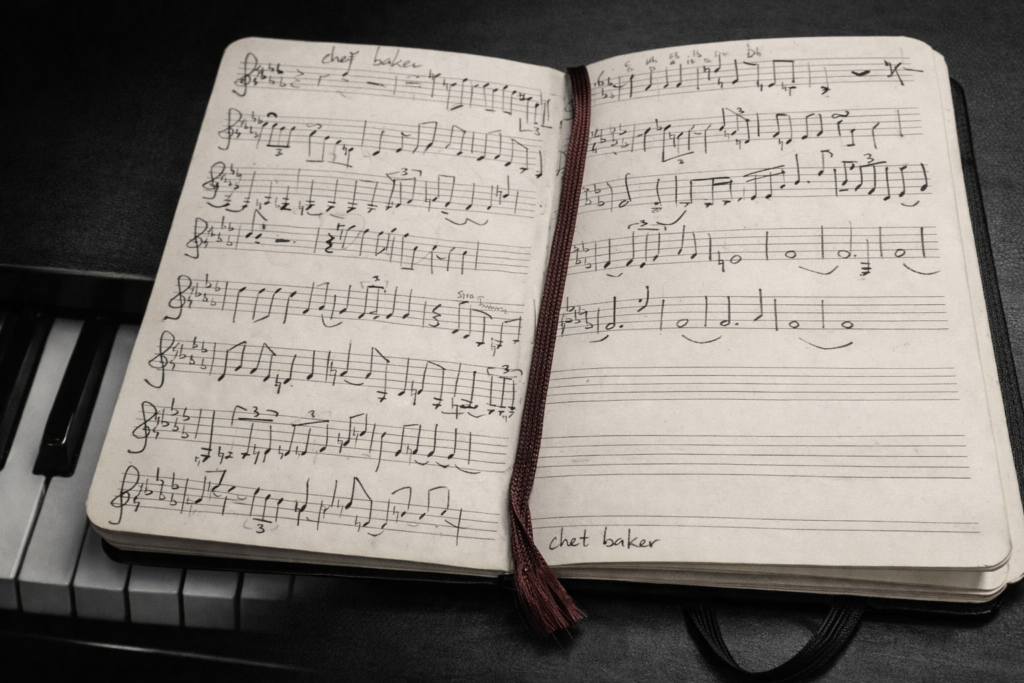
Jazz transcription

A handwritten transcription by me of a Chet Baker solo.

Index

Oscar Peterson

Miles Davis

Someday my prince will come
Freddy Freeloader

Dave Brubeck

Somewhere (w Paul Desmond)

Karel Boele

Herby Hancock

Cantaloupe Island

Roy Hargrove

Stan Getz & Oscar Peterson: I want to be Happy

I love both of these musicians. Their best-known meeting is the 1957 album Stan Getz and the Oscar Peterson Trio: just straight-ahead jazz, recorded fast, with musicians who trusted each other’s time feel completely. Peterson rarely crowds Getz; instead he leaves space, comps lightly, and lets the saxophone breathe. 

I transcribed the theme and Peterson’s solo. It’s breathtaking in its swing and energy, with a left hand that punches the bass notes for extra drive. It’s in the technique that his classical background becomes audible—at speed, with complete control, and always in service of the groove. A great exercise, and a humbling one too.

Oscar Peterson - Paper Moon

This solo on Paper Moon is another clear example of masterful swing timing and blues vocabulary. I transcribed both themes at the beginning and end of the track, as well as Peterson’s solo in between. I didn’t transcribe Herb Ellis’s guitar solo.

The Dave Brubeck Quartet - Somewhere

The piece is based on Leonard Bernstein’s Somewhere from West Side Story, but Brubeck treats the familiar theme almost like a fugue: the melody is passed from instrument to instrument, each voice entering in turn, slightly reframed.

I transcribed this mainly because of Paul Desmond’s solo. It’s disarmingly singable—purely lyrical, almost vocal. Underneath, Brubeck comps with unusual restraint: harmonically simple (by his standards), warm, and supportive. When Brubeck takes his own solo, the rhythmic complexity returns. I postponed transcribing some of the more intricate bars—see where that gets me?

Another striking detail is the stereo image. The instruments are panned extremely wide: the drummer hard left, Brubeck to the right, Desmond straight ahead. Close your eyes and you’re sitting inside the band.

Oscar Peterson - Stormy Weather

Another piece from Oscar Peterson Plays Harold Arlen. This time a swinging solo at a more relaxed tempo—an excellent example of how to embellish a strong melody without losing its shape. I notice I didn’t transcribe the block chords in the solo. A shame, because those are especially instructive.

Roy Hargrove - Dexterity

This one was recommended to me by my teacher in my first year. At the time, my transcription skills weren’t fully developed—which is very obvious when I read it back now. What stayed with me from this solo is how much interest you can create purely through rhythm: don’t start every phrase on the one, don’t always resolve on the three.

It was also my first real encounter with playing over a pedal point: the bass stays on a single note, the tonal center remains fixed, and the challenge shifts from navigating chord changes to shaping melody and rhythm within that static harmony.

Solo starts at 41 seconds in.

Karel Boehlee - In my Dreams

One of those songs where I thought upon first listening: this is so wonderful… I just want to be able to play this. And thus started the work of transcribing this great pianist’s playing.

A funny side note to this transcription: when I played it for my teacher after finishing it, she said she’d like a copy to use with other students. In the weeks that followed, I’d occasionally hear it echoing through the conservatory halls, played by other (secondary-subject) students. That made me quietly proud.

Oscar Peterson Trio - Band Call

I once did a project focused on improving my trio playing—working with double bass and drums—using the Oscar Peterson Trio as my main reference. For obvious reasons, I loved that trio.

That’s why you’ll find quite a few Peterson transcriptions here, and also why I transcribed the entire tune in this case: not just the solo, but the full form as well. And honestly—Night Train is simply one of the great albums. Few albums swing this hard. 

Wynton Kelly's Solo on Freddy Freeloader by Miles Davis

Speaking of iconic albums, Kind of Blue is certainly one of them. Many stories have been told about the recording of this record.

Freddie Freeloader is the only track on the album with Wynton Kelly at the piano instead of Bill Evans. Miles wanted Kelly on this tune for his old-school, driving blues feel. Evans, with his lighter touch and harmonic openness, was a better fit for the rest of the album, which explored this then-new modal approach to improvisation.

Kelly only plays on one track—but he absolutely nails it. Inspired by his feel, I transcribed his solo. Solo starts at 0:45s. 

Want to play one of these transcriptions?

Comment down below!

Ask and thou shalt receive…

Thanks for reading!

Stay updated?

Drop me your mailadres and I’ll send you an email whenever I’ve got something new to share. I won’t send more than 4 mails a year.

Leave a Reply

Your email address will not be published. Required fields are marked *