Classical Appreciation Post

Bach - Busoni

Nun komm, Der heiden heiland

(BWV659)

I trained as a jazz pianist, but the curriculum made sure I got my fair share of classical technique too: posture, touch, control, discipline. Some of the pieces from that time have started calling me back, and I’ve also begun picking up a few new ones.

This is one of those new ones. I had the recording on repeat for days and caught myself thinking: could I actually play this? That same evening I printed the sheet music.
The Song

Johann Sebastian Bach spent most of his working life writing church music, simply because that was what you did with such talent back then. And when the church calendar said “Advent,” you wrote something for Advent. Nun komm, der Heiden Heiland was one of those yearly fixed themes, so in his life Bach ended up using this Lutheran chorale four times: BWV 61 (1714), BWV 62 (1724), BWV 599 (his early Orgelbüchlein version), and BWV 659 (a later, larger organ prelude).

That last one — BWV 659 — is the version Ferruccio Busoni picked up a couple of centuries later and reshaped for piano. It’s nice to realise this piece only exists in its current form because it passed through several hands over several centuries: the original Latin chant, Luther’s reworking, Bach’s multiple reworkings, and finally Busoni’s.
A kind of long-distance relay where each composer hands the tune to the next. And now, it’s in my hands… (sorry, had to do it).

About chorales and cantos

This is an Advent chorale: a melody and text that returned every year in church services leading up to Christmas. The central line of the tune — the canto, meaning the main chorale melody — is the slow, steady backbone that everything else grows around.

In BWV 659 the canto appears four times. You can actually see this in the sheet music: Bach writes Canto above the staff so the performer knows exactly where each entry begins. These are the direct references to the Lutheran hymn Nun komm, der Heiden Heiland. They’re meant to stand out, written on the top line, played a little louder than the other voices. They aren’t identical: they start on different beats or contain small variations, which gives the melody a slightly shifted feeling each time, even though they’re based on the same tune.

Performers

Two pianists have this Bach–Busoni arrangement in their repertoire and play it regularly: Vladimir Horowitz and Evgeny Kissin.

Their interpretations aren’t wildly different, but their pacing is. Kissin plays it slower. Horowitz, to me, has more emotion and is more touching — and judging by the YouTube comments, I’m not alone. Maybe it’s the setting too (check out the video). Your favorite grandfather, in a cosy retirement home (that just happens to have a grand piano), playing this phenomenal piece. World-class. The volume control, the ease, the simplicity of how he makes it look — it’s all world-class. And when, at the end, Horowitz is complimented, he simply responds with a modest: “Well, I didn’t write it.”

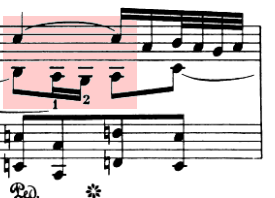
I noticed a small detail at 3:38 in the Horowitz recording: Busoni wrote a slightly different line compared to the previous canto entry, but Horowitz simply repeats the earlier material. I decided to imitate this, as a tiny nod to Mr. Horowitz

Challenges

One of the reasons I’m drawn to this piece is the independent voice-leading. Pop music — even jazz — often thinks in chords with one melody above. Bach doesn’t. In his world every line is its own melody with its own little journey, and the harmony is basically the accidental by-product of all those individual lines interacting. Playing it feels wonderful, but there’s also a lot to unpack theoretically. So much thought and skill went into these “puzzles.”

That independence also makes the piece tricky on the piano. The long chorale line needs to stand out but stay calm and steady, while the inner voices quietly wriggle around it. If your fingering is even slightly off, you break the legato — the melodic continuity — and you immediately hear it. And then there’s the volume control needed to create the layering: the listener should be able to hear the different lines as if they were different instruments, each with its own expression.

And then there’s Busoni’s love for wide stretches. Some of his chords suggest he assumed the pianist had hands the size of small paddles. Look at the Horowitz video: clearly not a problem for him, with those big, friendly-giant hands. And again, I’m not alone — one YouTube comment said: “I tried playing this, thinking it was easy. I couldn’t stretch my hands far enough for over half the piece.”

Hope you enjoy my take on this beautiful chorale prelude by Luther, Bach, Busoni, a little Horowitz, and played by me.

I’m curious what you think!

Share your thoughts?

Leave a reply down below and let me know!

Thanks for reading!

Stay updated?

Drop me your mailadres and I’ll send you an email whenever I’ve got something new to share. I won’t send more than 4 mails a year.

Leave a Reply

Your email address will not be published. Required fields are marked *